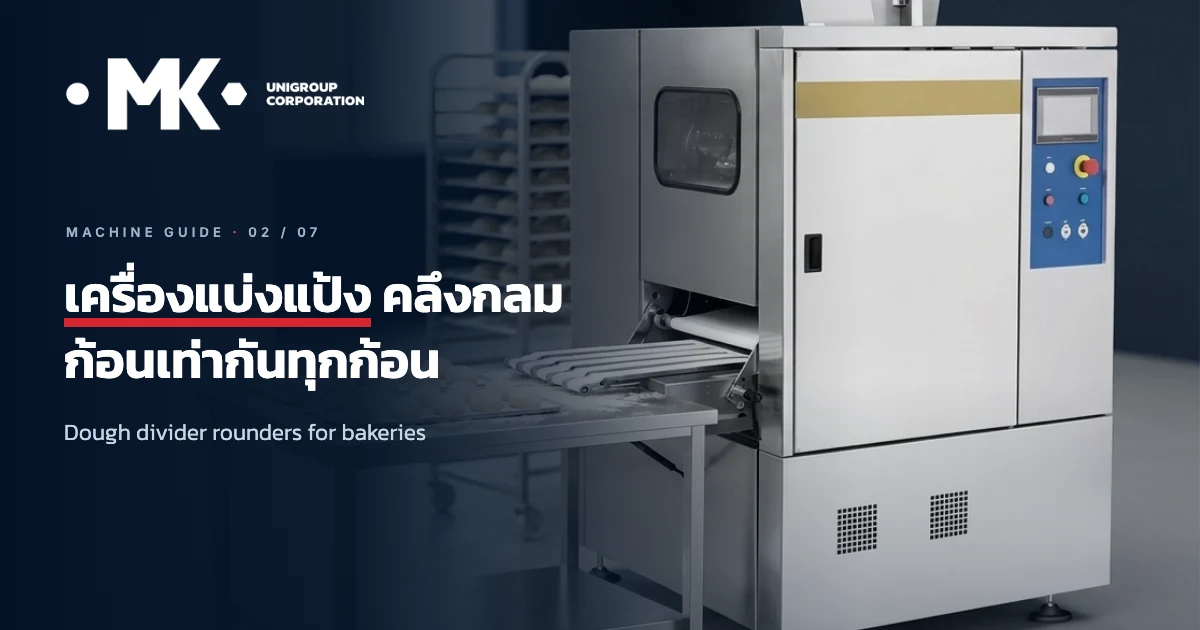
A dough divider rounder presses dough, cuts it into pieces and rounds each piece into a ball in one working cycle. A bakery gets dough balls of near-identical size without staff weighing and shaping every piece by hand. Models range from lever-operated units for bakeries to multi-row machines for production plants.
The MK Unigroup team and management have sold, planned, installed and serviced bakery machinery in Thailand for more than 20 years. Machine figures in this guide come from product data published by RAM and Sottoriva of Italy, both distributed by MK.
How a dough divider rounder works
A time-consuming stage in bread making comes after mixing, when dough has to be cut, weighed and rounded piece by piece before resting and shaping (see our overview how bread is made, in Thai). A dough divider rounder brings this stage into one machine, using one of two main systems:
- Plate-fed (RAM): place a dough piece on a plate, insert it, and the machine presses, cuts with knives and rounds all pieces together. Suits bakeries running several recipes a day.
- Hopper-fed, continuous (Sottoriva): dough from the hopper is metered into portion chambers at the set weight, then rounded and carried out on a belt. Suits lines making the same product in volume.
Dough divider rounder vs dough divider
A dough divider such as the RAM DSA or DSS only cuts dough into equal-weight square pieces, which suits croissants, donuts or dough that will be sheeted and shaped later. A dough divider rounder adds the rounding step, so it fits products that start as a ball: round rolls, burger buns, pita and pizza bases. If your main products never start as a ball, a divider alone may be the better buy.
Choosing a dough divider rounder for a shop or a plant
| Segment | Model | Operation | Manufacturer data |
|---|---|---|---|
| Bakery / pizzeria | RAM S | Lever controls press, cut and round | Rounding motor starts when cutting ends and the lever is released; safety system |
| Bakery / pizzeria | RAM SPH / SPH Plus | One button: automatic press, cut and round | PLC with Siemens display for timing; SPH Plus supplied with 3 PETG plates |
| Large shop / central kitchen | Sottoriva Lyra | Automatic, 2 rows | 15 kg hopper; 30–125 g pieces (S: 40–180 g); 2,100–3,300 pcs/h |
| Plant | Sottoriva Dinamica | 4, 5 or 6 rows | 20 kg hopper; 800–1,600 pcs/h per row; 20–180 g depending on set-up |
| Plant | Sottoriva Athena Plus | 4, 5 or 6 rows | 35 kg Teflon-coated hopper; 1,000–2,000 pcs/h per row |
| Plant | Sottoriva Large Plus | Multi-row, 50-program touch screen | 25 kg Teflon-coated hopper; 1,000–2,500 pcs/h per row |
Bakeries making many breads in modest volumes usually start with the RAM SPH or RAM S, because each plate can be a different recipe. Shops producing large numbers of round rolls every day should look at the Sottoriva Lyra, and plants supplying burger buns or pita to large customers move up to the multi-row models. See every model in our dough divider rounder category.
What to check before you order
- Piece weight range: list the dough weight of every product and compare it with the machine's range. Sottoriva's plant models use rounding drums that each cover a specific weight range, so the manufacturer asks for the range at the time of order.
- Dough type: Sottoriva lists the Dinamica and Large Plus for soft to semi-tough doughs. If your dough is unusually stiff or sticky, test it on the machine first.
- Hourly output: size the machine on the number of pieces you need in your busiest hour, not the daily average.
- Space and power: for example, the Lyra measures 1,740 × 1,140 × 1,950 mm, weighs 540 kg and has a 1.30 kW motor, so plan the delivery route and floor loading. For other models, have technicians survey the site first.
- Operators: lever models rely on operator skill, while push-button or touch-screen models with stored programs help new staff match experienced staff.
Getting even dough balls from a dough divider rounder
- On plate-fed models, weigh the dough for every plate to the same weight, since the machine divides what is on the plate.
- Set weight correctly: the RAM SPH uses the sliding scale on top of the machine, and the SPH Plus uses the orange rod that opens the rounding chamber.
- On Sottoriva models, match rounding to the dough; for the Lyra, the manufacturer states both rounding speed and amplitude are adjustable.
- Check-weigh balls through each shift and post the settings for each recipe next to the machine.
Care and common mistakes
Many models are designed for easy cleaning. The RAM SPH and SPH Plus have a knife-cleaning push-button, the plates are food-grade PETG, and the machines stand on braked rubber castors so they can be moved for floor cleaning. Mistakes our team sees often:
- Choosing on maximum output when the weight range does not cover some of the shop's products.
- Leaving no space around the machine for trays, so work backs up at the outfeed.
- Training only one shift, so settings differ and dough balls vary.
A divider rounder is one step in a bread line. Look at MK Unigroup's full range of bakery equipment, from mixers to ovens, so every step runs at the same pace.
If you are comparing which dough divider rounder suits your bakery, the MK Unigroup team can review your recipes, piece weights and kitchen space. Free consultation: call 02-291-7400 or LINE @252zmycp.