

Everyone wants to be a great cook. Today we'll show you that delicious baking really isn't difficult once you know a few good tips.
Bakers know that creating products that taste great and keep customers coming back depends on the basic ingredients: sugar, eggs, flour and milk, each with different properties and roles. So how do you choose ingredients that give quality results and suit baking? Let's find out.
1. Sugar
Sugar sweetens and gives baked goods their brown colour after baking. Without sugar, bakes come out pale and don't rise. When creamed with butter and eggs it needs to dissolve quickly; if it dissolves slowly, the butter turns mushy, affecting the texture of baked goods and the shape of cookies, crackers and biscuits. Sugar also helps stabilise whipped cream and beaten eggs.
Tips for choosing the right sugar for baking:
- Granulated sugar: should be white, clean and fine so it mixes easily with other ingredients.
- Caster sugar: white sugar ground into smaller crystals. It is ideal for baking because it dissolves quickly, but use it promptly, as it absorbs moisture and clumps in storage.
- Brown sugar: contains caramel and moisture, making it perfect for fruit cakes and soft cookies.
- Icing sugar: used for dusting, decorating and glazing.
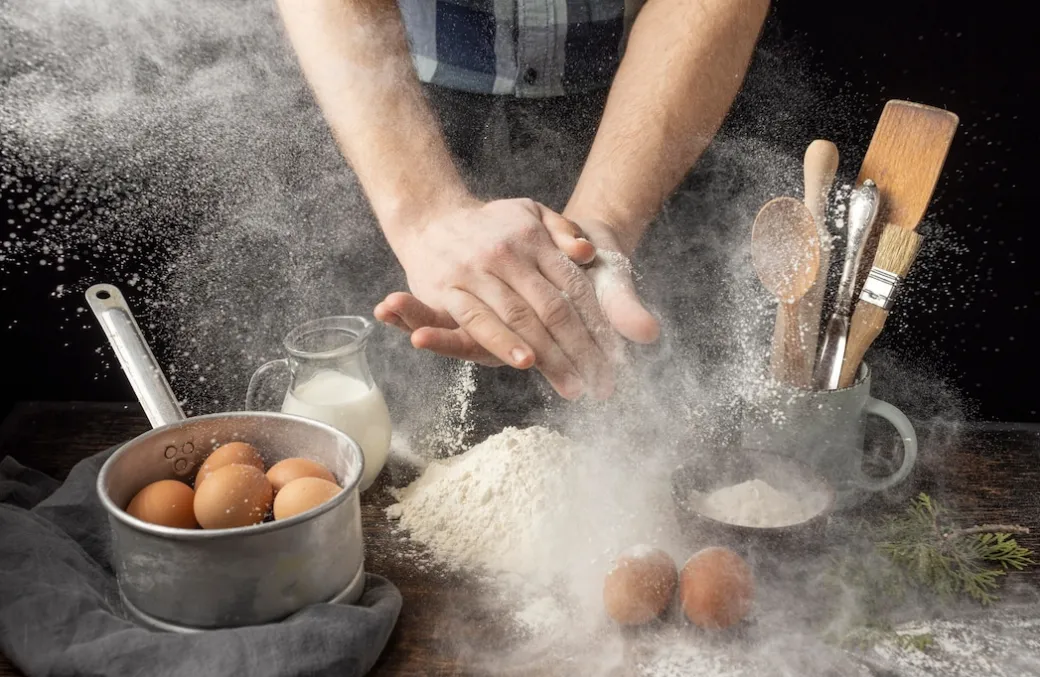
2. Eggs
Chicken eggs are the best choice for baking. Fresh eggs improve quality, deepen the colour of baked goods and help them rise easily and quickly. Avoid duck eggs, which are too large, make cakes tough and add an eggy smell. Baking normally calls for medium chicken eggs, size 3, each weighing about 50 g.
Tips for choosing eggs for baking:
- Choose rounder eggs, as they weigh more than oval ones.
- To find fresh eggs, look for shells with a powdery coating that feel smooth in the hand. Held up to sunlight, a fresh egg looks slightly reddish and translucent. You can also test eggs in water: fresh eggs sink, while old eggs float just below the surface.
Store fresh eggs in the egg compartment of the fridge at about 2–3°C. The cold keeps them fresh for up to 2 weeks; at room temperature they deteriorate quickly and last only 3–4 days.
3. Flour
Wheat flour is a key ingredient for the texture of baked goods and the main raw material. There are several types, depending on what you're baking:
- Bread flour: made from hard wheat, cream-coloured and coarse in texture. It can be used for all kinds of bread.
- All-purpose flour: made from a blend of hard and soft wheat and whiter than bread flour. It is suitable for pie pastry, patongko (Thai fried dough sticks) and cookies.
- Cake flour: made from soft wheat, very fine and whiter than both bread flour and all-purpose flour.
4. Milk
Milk binds the ingredients together into a smooth mixture. It adds moisture and flavour, and it brings out the taste, colour and aroma of all the other ingredients. That makes milk the most important element for perfectly balanced baked goods.
Simple tips for choosing evaporated milk: when you bake, milk quality is key.
- The colour should be creamy white with a hint of yellow, not yellow or brown, and not pure white.
- It should not smell off, as this will affect the aroma of your bakes.
- The fat content should not be too high, as it will throw off the balance of your recipe.
- It should be neither too thin nor too thick, with no separation, and fully homogeneous.
How to Store Evaporated Milk Correctly
Another advantage of evaporated milk is that it helps baked goods keep longer and spoil more slowly than those made with fresh milk. For example, custard made with fresh milk spoils faster at room temperature than custard made with evaporated milk. Even so, bakers should know how to store evaporated milk correctly:
- Store at normal room temperature, but once opened, use it within 24 hours.
- If you don't use it all and it comes in a can, transfer it to a container with a tight-fitting lid, because in the fridge the can may rust and a metallic smell can get into the milk while its aroma fades. Paper cartons are more convenient because they have a lid and are easy to store, and they are also 10% cheaper than cans, helping lower production costs.


