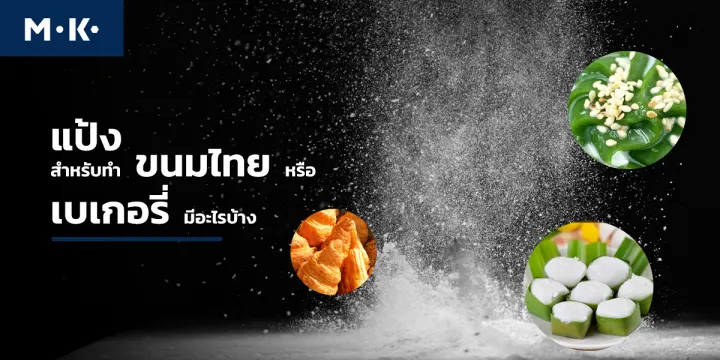
The key ingredient in Thai desserts, and even in bakery, is flour, and there are many types. Today MK Unigroup explains the different kinds of flour and what each one is like. Read on below.
Flour is an essential ingredient in most Thai desserts and bakery products, and it comes in many varieties. Each type of flour has different properties, which is why most recipes specify which flour to use. If you use a flour with very different properties, your dessert or bake may not turn out as intended. The main flours for desserts and bakery are as follows.
1. Rice Flour
Several kinds of rice flour are used in Thai desserts:
1.1 Old rice flour
As the name suggests, this flour is made from aged rice. It absorbs water well. The rice is polished and milled into a fine powder. It suits desserts such as khanom krok (coconut rice pancakes), khanom tan (toddy palm cake) and khanom rerai (steamed rice-flour strands).
1.2 New rice flour
Made from newly harvested rice. The obvious difference is that it has a more fragrant aroma than old rice flour, but it is high in moisture and absorbs little water. It suits desserts such as khanom piak pun (black pandan jelly), khanom kruay (steamed coconut cups), khanom paeng on, khanom tom daeng, khanom tom khao (coconut-filled rice dumplings) and khanom alua (melt-in-the-mouth fondant sweets).
1.3 Fresh rice flour
Ground with water, so it is moister than the flours above. It isn't very popular today because it is inconvenient to store; it is mostly milled in-house by dessert shops. If it smells sour, it shouldn't be used. It can be used for all Thai desserts, such as khanom tom daeng, khanom thuay (coconut custard cups), khanom tom khao and lot chong Thai (pandan rice-flour noodles).
2. Glutinous Rice Flour
There are two kinds:
2.1 White glutinous rice flour
Made by finely milling white glutinous rice. It comes in two forms, fresh and dry. The fresh form is made like fresh rice flour and is popular for bua loy (rice balls in coconut milk), khanom khai hong, khanom babin (coconut cakes) and khanom thua paep (folded mung bean dumplings). The dry form keeps for a long time, is convenient to store and use, and can be used for all Thai desserts. Choose flour without a musty smell or weevils.
2.2 Black glutinous rice flour
Made by finely milling black glutinous rice. White glutinous rice flour is usually mixed in so the flour isn't too dark. Black glutinous rice flour alone isn't soft and is rather coarse, so adding white glutinous rice flour gives the dessert a softer colour and texture. It comes in fresh and dry forms like white glutinous rice flour, and is popular for khanom thua paep and khanom sot sai (filled coconut dumplings).
3. Wheat Flour
Wheat flour is used widely in Thai desserts and bakery, and you can choose the right one for the job, because there are three kinds:
- Light wheat flour: used for light, fluffy treats such as bakery items, khanom puy fai (steamed cotton cakes), khanom sali (steamed sponge cake) and khanom khai (egg cakes).
- All-purpose wheat flour: used for bakery and crunchy savoury snacks such as krong krang (crispy shell-shaped snacks), thong muan (rolled coconut wafers) and khanom kliao (twisted crisps).
- Heavy wheat flour: not used for Thai desserts because of its high protein; it is popular for bread.
4. Mung Bean Flour
Made by grinding or pounding mung beans into a fine, clean white powder without colour or impurities. It holds its shape well, so it is often added to Thai desserts for structure and a translucent look. It is popular for sarim (coloured noodles in coconut milk), tako (coconut-topped jelly cups), khanom luem kluen and lot chong kaeo (clear jelly noodles).
5. Arrowroot Flour
Made from arrowroot tubers and processed into small, creamy-white granules. It is expensive and has properties similar to mung bean flour: it gives bright colour and holds its shape well. It is used in khanom chan (layered steamed dessert), tub tim krob (water chestnut "rubies"), khao kriap on, khao kriap pak mo (steamed rice-skin dumplings), khanom kruay and kalamae (coconut caramel).
6. Tapioca Flour
Made from cassava. It is special for its slippery, fine, soft texture and creamy-white colour. It is often mixed with other flours to enhance their properties. It is inexpensive and easy to find in markets. Many companies produce it today, each with different properties, so before using it in large quantities you should research or test it to get the properties you want. For example, some tapioca flours make desserts break down more quickly, while others are very chewy and durable. Choose one suited to the job, such as khanom chan or sangkhaya (coconut custard).
7. Cake Flour
The lowest-protein flour, made from soft wheat. It is popular for cakes and bakery because it gives a soft, fluffy crumb with a good texture.
8. All-Purpose Flour
A medium-protein flour made from a blend of hard and soft wheat. It can be used for many kinds of bakes.
9. Cornflour
Made from corn, with a fine, slippery texture and creamy-white colour. It is often mixed with other flours to improve structure, shine and softness, as in khanom chan and sangkhaya. Buy and store it as you would tapioca flour.
10. Filling Flour (Modified Starch)
A fine, white flour, also commonly mixed with other flours.
Follow MK Unigroup for more news about desserts and bakery. We have plenty of articles for you.