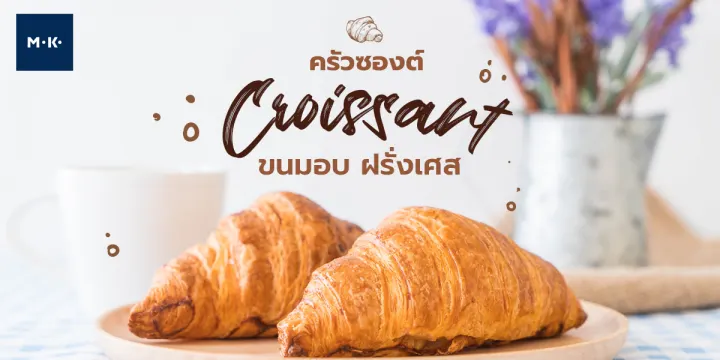
Many people love croissants, but do you know their history? Today MK Unigroup tells the story of the croissant and why it became a French pastry so many people adore.
From Vienna to Paris
The croissant really did originate in Vienna, Austria. It was adapted from the crescent-shaped Kipferl, whose name means "crescent" in German, and the story dates to around 1683 and the war between the Turks and Vienna.
Records from the 13th century describe the Kipferl, the croissant's ancestor, in many forms, made from plain dough or with nuts or other ingredients. The croissant evolved from the Kipferl before viennoiserie was invented in late 1839 (some say 1838), when Austrian officer August Zang opened a Viennese bakery in Paris. The bakery offered specialities from typical Viennese recipes, such as Kipferl and Viennese pastries. It became so popular that it inspired French bakers to copy it, and the Kipferl came to be named after its crescent shape. That distinctive shape made it famous worldwide.
Alan Davidson, editor of the Oxford Companion to Food, found no croissant recipe in French cookbooks before the 20th century. The earliest French reference is under the heading "fancy or luxury breads" in Payen's "Des substances alimentaires" of 1853. The first reference to the croissant's origins in France dates to around 1850. In 1848, Zang returned to Austria to work in the press, but his bakery remained popular and was recommended in the media. By 1869 the croissant had become famous as a breakfast food, and in 1872 Charles Dickens also mentioned croissants on the breakfast table. The technique behind today's croissant is traced to the late 17th century, when La Varenne's Le Cuisinier françois developed a recipe in 1680 or earlier, but the croissant itself was not mentioned until the 20th century.
Croissants Today
The croissant has become a staple in many French pastry shops. In the late 1970s, factories developed frozen ready-to-bake dough, turning it into a product that could be prepared quickly and easily without baking skills. The French croissant became one of the clearest answers to American fast food. Today, 30–40% of croissants sold in French bakeries are baked from frozen, and croissants remain a breakfast favourite to this day.
How Many Types of Croissant Are There?
There are many kinds of croissant, with sweet fillings such as chocolate, or savoury fillings such as cheese and ham.
The original plain croissant is made with butter. It is difficult to make and requires time for the dough to rest, giving a croissant that is crisp outside and soft inside. Croissants made with margarine suit people who don't want to eat butter, or countries where butter is expensive. The main types are:
- Plain croissant (straight croissant): the basic, classic croissant.
- Crescent croissant: crescent-shaped, close to the traditional style.
- Diamond croissant: wider than the straight croissant and popular for adding fillings.
- Laugen croissant: similar to the plain croissant but with richer butter and a darker colour.
- Flaky croissant: a butter croissant with a pastry-like texture, lighter and puffier.