

On a rushed morning, rice isn't always the answer. Today we introduce the bagel, a much-loved breakfast with endless flavour possibilities.
The Origins of the Bagel
Let's get to know the bagel. It is a popular Western breakfast, eaten from Eastern Europe to the Americas and the rest of Europe, filling, satisfying and delicious in many ways. Bagels were created by Jews in Poland, who devised a bread with a slightly crisp outside and a dense, chewy inside, a texture unlike ordinary bread. Records show that in 1610 the Jewish community in Poland made bagels as food for new mothers after childbirth. Other evidence suggests that Poles had been making bagels since the Middle Ages, with the hole in the middle symbolising magical powers.
Another legend says a Viennese baker created the bagel in the 17th century as a gift for the King of Poland, who led an army to defend Austria from a Turkish invasion, though many say this is unlikely to be the bagel's true origin. Others claim a bagel recipe appears in the cookbook of a baroness in Hertfordshire, The Receipt Book of Baroness Dimsdale (c. 1800), under the name "Hertfordshire nut". Some even claim that the doughnut, a ring-shaped bread that is fried, began here, written as "dow nuts".
How Bagels Are Made
In fact, Jews made bagels before anyone else. The hand-kneaded dough is shaped into a ring with a hole in the centre, boiled in water at just the right simmer and turned so both sides cook evenly, then baked. This gives a crisp outside and a dense, chewy inside. Boiling techniques vary from recipe to recipe: the longer you boil, the thicker the crust and the denser rather than fluffier the crumb. Boil too long and the bagel becomes overly dense and chewy and doesn't taste good. So boiling time is about 30 seconds, or 60 seconds in some recipes. When baked, the dough rises but stays denser than bread.
Why Do Bagels Have a Hole?
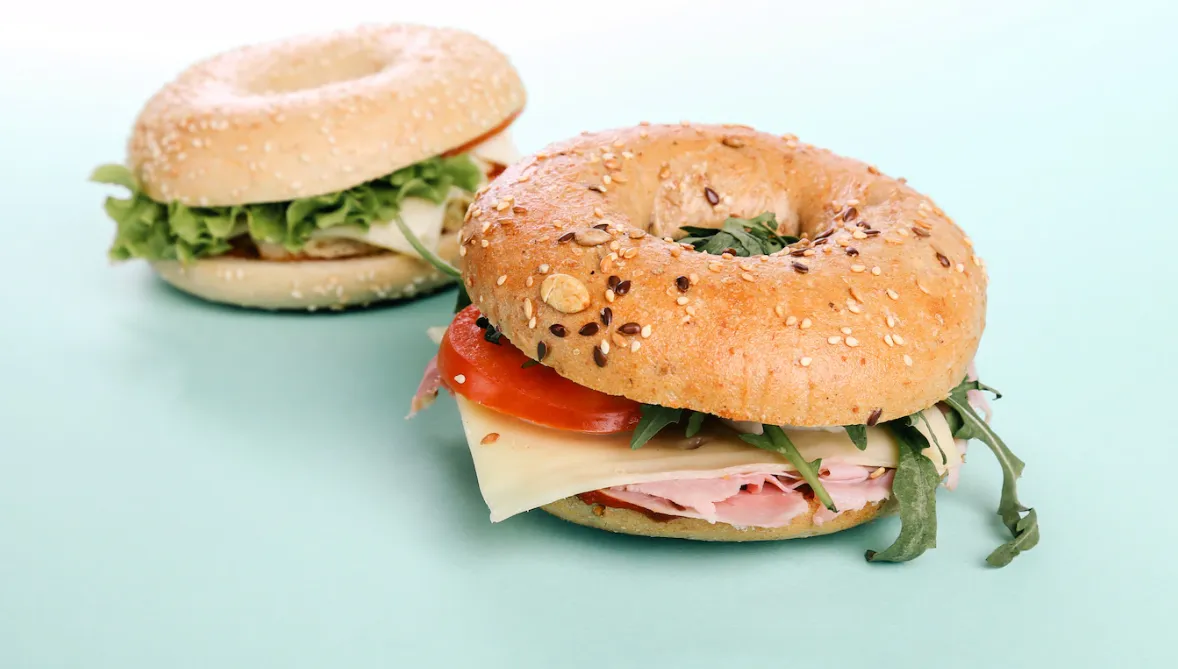
The hole helps the dough cook easily and evenly, and makes bagels easy to hold. Sliced in half, they can take all kinds of fillings like a sandwich: smoked salmon, egg, ham, avocado, cream cheese, hummus, onion and fresh vegetables. Ingredients can also be mixed into the dough, such as chocolate chips or raisins with cinnamon (delicious when mixed well), dark cocoa, green tea, riceberry rice, oats or rye. Bagels can be made into desserts too, topped with blueberries, strawberries, peanut butter or honey. Bagel recipes really are endlessly delicious.

How Bagels Spread Around the World
When Jews emigrated to New York, they brought their bagel recipes with them. Germans say the pretzel, eaten since the 14th century, has the same texture as the bagel, and that "bagel" comes from the German "Bougel", meaning "bracelet". When Germans emigrated to America they brought pretzels too. Both were street foods: cheap, filling food for ordinary people.
In England, people in Brick Lane in London's East End also loved bagels, with bagel shops there in the 19th century. By the late 20th century the bagel was eaten throughout North America, and a bagel industry emerged, producing "frozen bagels" from 1960. To produce in volume, manufacturers cut production time by steaming instead of boiling and baking, cooking the bagels in a single step. This lowered costs and gave the bagels a shiny, appetising surface, but the inside isn't as chewy as a traditional bagel.
Bagels became popular in New York and were loved in Canada too, giving rise to the Montreal bagel, and the two cities compete over whose bagels taste better. Later Chicago, California and Oregon styles joined the contest. Before long bagels became famous in France, while Londoners still prefer bagels with a coarser crumb and more air bubbles inside.

How Many Calories Are in a Bagel?
A standard bagel 3.5–4 inches in diameter provides about 300 calories and 1.5 g of fat. A large one provides 500–600 calories, equal to 6 slices of bread. Spreading cream cheese adds another 50 calories, plus whatever toppings you add. For a healthier bagel, choose whole wheat flour or add grains such as white and black sesame, oats, rye, pumpkin seeds or poppy seeds.
Why Do Bagels Lift Your Mood?
The carbohydrates in a bagel help stimulate the body to release serotonin, which makes you feel calm. Some studies have found that giving starchy foods to people with depression helps improve their mood.
Now that you've got to know the bagel, aren't you feeling hungry?